Total Solids Measurement for Industrial Process Control
Reliable concentration data for automated control, optimization, and consistent production
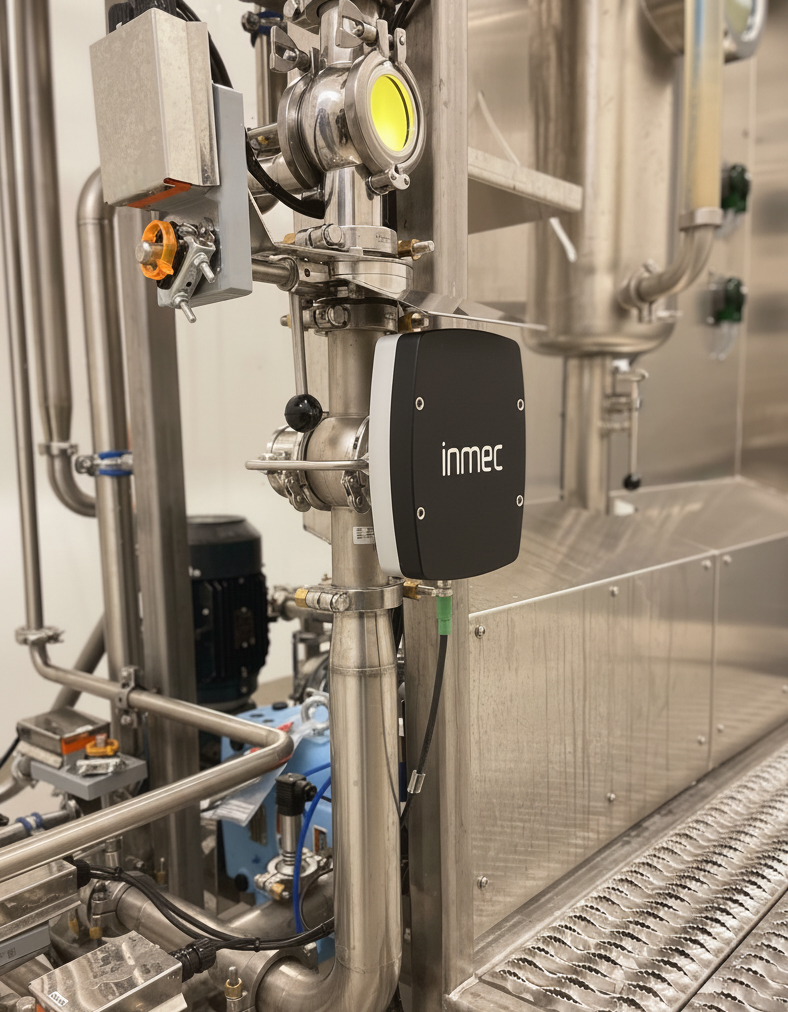
Effective Process Control Starts with Reliable Measurement
Modern industrial process control depends on accurate, continuous measurement data. Automated control systems can only be as good as the sensors that feed them—without reliable input signals, even the most sophisticated control strategies fail to deliver consistent results.
Concentration measurement plays a critical role in process control across industries. Whether maintaining product specifications in continuous production, optimizing energy consumption in evaporation, or ensuring batch consistency in mixing operations, real-time Brix and total solids data enables the tight control required for efficient, profitable operations.
Inmec’s digital microwave sensors deliver the stable, drift-free measurement data required for effective process control—from simple monitoring and alarming through closed-loop PID control and advanced process optimization—providing reliable signals that control systems can trust for automated decision-making.
The Challenge: Why Process Control Requires Reliable Sensors
Effective automation and process control demand measurement technology that delivers consistent, trustworthy data under real production conditions:
Control Loop Stability
Unstable or noisy sensor signals cause control systems to hunt, oscillate, or make incorrect adjustments. Drift over time undermines control performance and requires manual intervention.
Real-Time Response
Process control requires immediate feedback. Sampling delays prevent timely adjustments and result in off-spec production, wasted materials, or inefficient energy use.
Long-Term Accuracy
Control strategies based on historical data or predictive models require sensors that maintain calibration over weeks, months, or years without drift or degradation.
Harsh Process Conditions
Industrial processes involve coating, temperature variations, and demanding environments. Sensors must deliver stable data despite these conditions—not require frequent cleaning or recalibration.
Multi-Point Integration
Modern control systems often require measurement at multiple process points. Inconsistent sensor performance across locations undermines overall control effectiveness.
Operator Confidence
If operators don’t trust the measurement data, they override automation and revert to manual control—negating the benefits of process automation entirely.
How Inmec Sensors Support Process Control
| Control Requirement | Typical Challenge | Inmec Sensor Performance |
|---|---|---|
| Signal stability | Noise, drift, coating effects | Stable, low-noise signal for reliable control |
| Response time | Sampling delays, slow sensors | Real-time continuous measurement |
| Long-term accuracy | Drift requires recalibration | No drift, no routine recalibration needed |
| Harsh conditions | Coating, fouling, temperature | Unaffected by surface coating, auto temp compensation |
| Multi-variable output | Multiple sensors for different parameters | One sensor outputs Brix, density, total solids |
| Control loop suitability | Signal quality insufficient for automation | Clean signal ideal for PID control |
Process Control Applications
Inmec sensors support concentration-based process control across diverse industrial applications—from basic monitoring and alarming to advanced closed-loop automation.
Monitoring and Alarming
Process Visibility and Exception Handling
Continuous concentration monitoring with alarm outputs alerts operators to process deviations before they result in off-spec production or equipment problems.
How it works:
Sensors provide continuous concentration data to SCADA or DCS systems. High/low alarms trigger when concentration moves outside acceptable ranges, enabling operator intervention before problems escalate.
Typical applications:
- Product quality monitoring and verification
- Process deviation detection
- Equipment performance monitoring
- Trend analysis and process optimization
- Predictive maintenance triggers
Key benefits:
- Early problem detection – identify issues before they affect quality
- Reduced operator workload – automated monitoring vs. manual checks
- Historical data – trend analysis supports process improvement
- Quality assurance – continuous verification vs. periodic sampling
Inmec solution: Stable, continuous measurement with configurable alarm outputs. Integration with existing SCADA/DCS systems for centralized monitoring and data logging.
Closed-Loop PID Control
Automated Concentration Control
Direct use of concentration measurement in closed-loop control systems enables automated adjustment of process variables to maintain target specifications.
How it works:
Sensor output feeds directly into PID control loops. The controller compares measured concentration to setpoint and automatically adjusts valves, pumps, or dosing systems to maintain target specifications.
Typical applications:
- Evaporator endpoint control (automated steam/feed adjustment)
- Blend ratio control (automated component dosing)
- Dilution control (automated water addition)
- Batch endpoint detection (automated process termination)
- Continuous product standardization
Key benefits:
- Consistent product quality – automated control eliminates human variability
- Reduced waste – precise control minimizes off-spec production
- Energy optimization – automated endpoint detection prevents over-processing
- Increased throughput – faster, more confident process transitions
Measurement requirements for closed-loop control:
- Signal stability (no drift or noise that causes hunting)
- Fast response time (enables timely adjustments)
- Accuracy (prevents systematic offset in control)
- Reliability (control depends on continuous availability)
Inmec solution: Drift-free measurement with fast response and low signal noise. Standard industrial outputs (4-20mA, Modbus) integrate directly with PLCs and DCS systems. Stable signal quality suitable for tight PID control loops.
Advanced Process Optimization
Model-Based Control and Predictive Strategies
Integration of continuous concentration data into advanced process control strategies enables optimization beyond simple setpoint maintenance.
Typical applications:
- Energy optimization in multi-effect evaporators
- Yield maximization in crystallization
- Recipe optimization in batch processes
- Predictive maintenance based on process trends
- Statistical process control and six-sigma initiatives
How concentration data supports optimization:
- Real-time process modeling and simulation
- Identification of optimal operating conditions
- Detection of equipment degradation or fouling
- Validation of process improvements
- Data-driven decision support
Inmec solution: Continuous, accurate data with no drift enables long-term trending and model validation. Multi-variable output (Brix, density, total solids) from single sensor provides comprehensive process insight.

Stable signal for closed-loop control
Drift-free, low-noise measurement provides the reliable input required for automated PID control—not just monitoring or indication.

Continuous real-time data
Immediate feedback enables responsive control adjustments without the delays inherent in manual sampling or batch analysis.

No recalibration disruptions
Maintains accuracy over months and years of continuous operation—eliminating production interruptions for sensor maintenance or verification.
Let’s Improve Your Process Control Application
Give us a brief description of your measurement process and our experts will get in touch.
Why Digital Microwave Measurement Enables Better Control
Unstable sensors undermine control performance
Signal drift over time causes control offset. Coating-induced noise creates hunting and oscillation. Slow response delays control action. Frequent recalibration interrupts production.
Inmec sensors deliver control-grade signals
Drift-free measurement maintains setpoint accuracy over months and years. Coating resistance eliminates noise from fouling. Fast response enables timely control action. Continuous operation without recalibration.
The practical difference:
Control systems can only perform as well as their input sensors allow. Inmec sensors provide the signal stability, accuracy, and reliability required for confident automated process control.