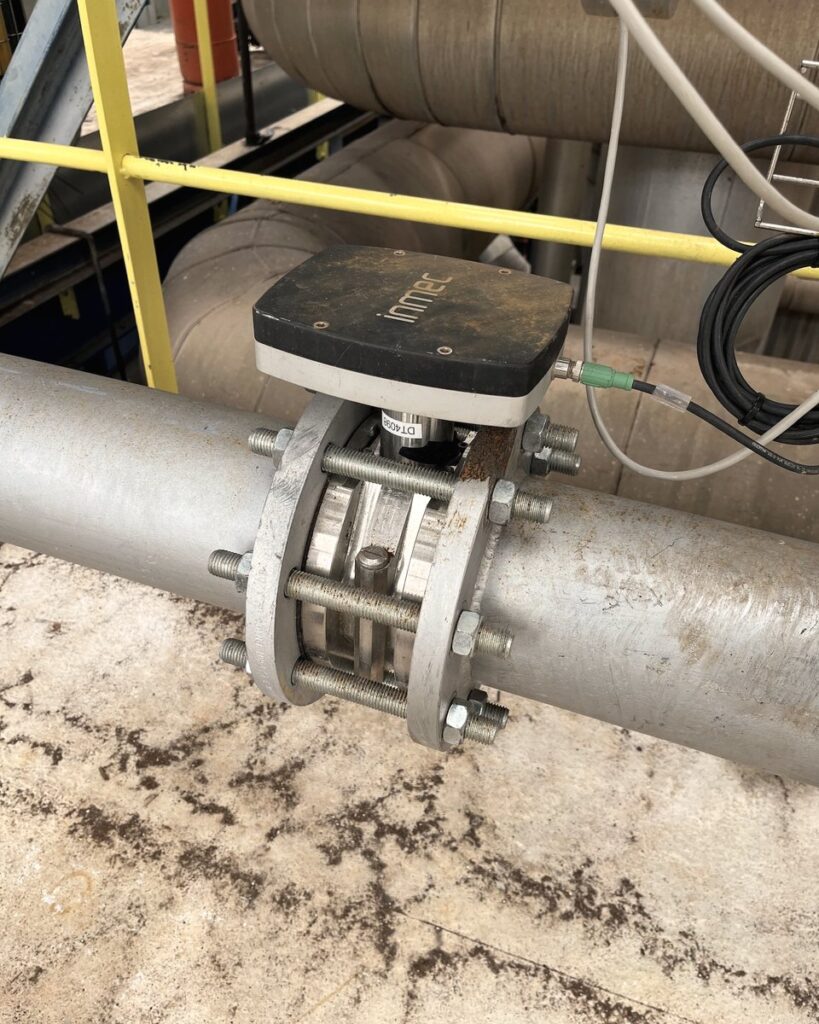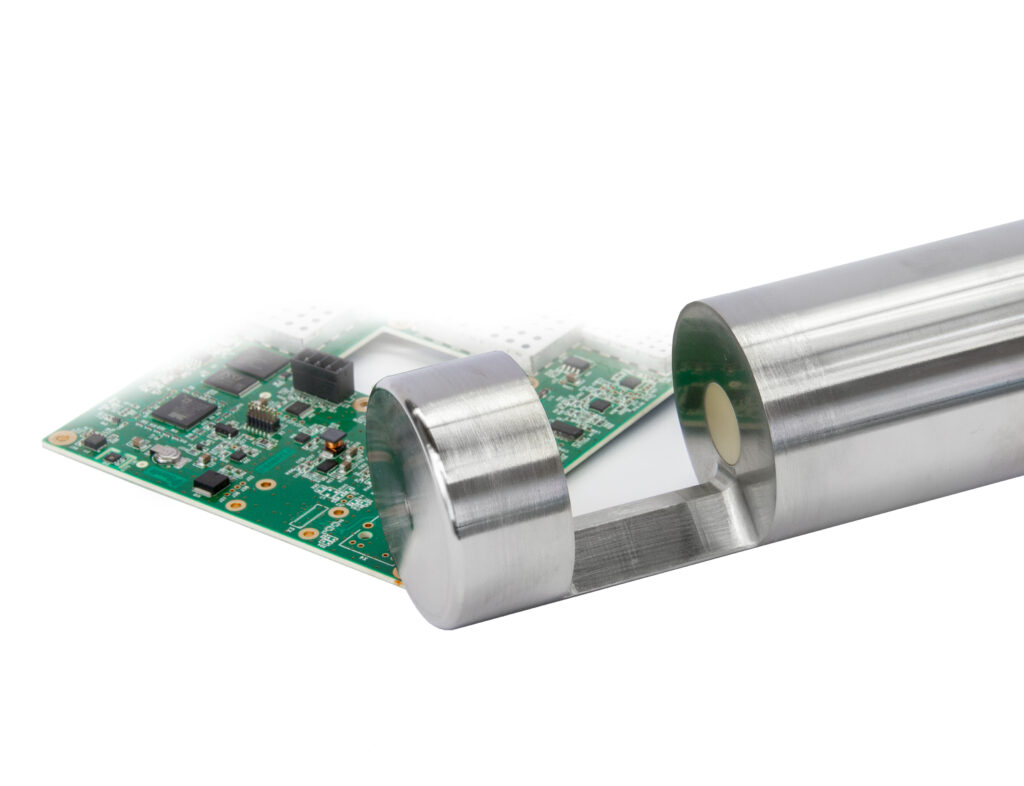
In short: optical sensors measure through a window or prism using light, which works best in clean, homogeneous liquids. Digital microwave sensors measure total solids, both dissolved and suspended, through the product volume. That makes them the stronger choice where coating, pulp, crystals or wide concentration ranges are part of normal operation. Inmec’s digital microwave sensors run without drift or recalibration through full production campaigns, backed by a 3-year warranty.
Key takeaways
- Optical sensors read at an optical surface (prism, window or lens). Digital microwave reads the bulk product.
- Coating on an optical surface affects the reading. Coating on a digital microwave sensor does not.
- Refractometers measure dissolved solids only. Digital microwave measures total solids, including pulp and crystals.
- Digital microwave needs free air removed (at least 1.5 bar process pressure) and product conductivity up to 13 mS/cm. The Inmec Ci extends this to low-purity, high-conductivity products in both pipelines and tanks.
Brix vs total solids: why the difference matters
Brix is the dissolved solids content of a liquid, mainly sugars. Total solids also includes suspended material such as pulp, fibre, protein, fat and sugar crystals. In clear syrups the two are nearly the same. In juice concentrate, dairy concentrates, massecuite and slurries they are not, and those processes are controlled on total solids.
A sensor that sees only the dissolved part can report a stable value while the actual product composition changes.
How optical sensors work
Optical inline sensors use the way light interacts with the product to determine concentration. Three types are common:
- Refractometers measure the refractive index at a prism or sapphire window. The refractive index rises with dissolved solids.
- Turbidity sensors measure how suspended particles scatter light.
- NIR (near-infrared) sensors measure light absorption at specific wavelengths.
Why refractometers miss suspended solids: a refractometer reads the refractive index of the liquid phase at the prism surface. Suspended particles and crystals do not change that index, so they are not part of the reading.
In a pulpy juice the refractometer reports the Brix of the liquid around the pulp; in massecuite it reads the mother liquor between the crystals.
Where optical sensors perform well
- Clear, homogeneous liquids such as soft drinks, clear syrups and sugar solutions
- Stable process conditions with regular maintenance access
- Dissolved solids in clear liquids, where refractometers in particular offer high precision
Where they reach their limits
- Optical surface: coating, scratching or clouding of the prism, window or lens shifts the reading, so cleaning or washing is needed
- Method-dependent: refractometers see dissolved solids only; turbidity and NIR are affected by colour, particles and bubbles
- Fouling products: massecuite, molasses and protein-rich concentrates foul optical surfaces quickly
How Inmec digital microwave sensors work
Water has a much higher dielectric constant than sugars and other solids, so a microwave signal passing through the product changes with its water content. Inmec sensors measure that change as a phase shift and convert it to total solids, °Bx or density.
- Digital Signal Synthesis (DSS) precisely synchronizes the transmitted and received signals, giving a high-resolution, noise-free measurement.
- Multivariable Measuring Algorithm (MMA) processes the signal inside the sensor and enables the wide measuring range.
- 720° phase range lets one sensor follow very wide concentration changes, such as a full vacuum pan strike, without range switching.
- Bulk measurement: the measurement extends into the product volume, so coating on the sensor surface does not cause drift.
Where digital microwave performs best
- Products with coating, buildup or crystallization
- Pulp, fibre, protein, fat or suspended particles
- Wide concentration ranges in one process
- Continuous processes that need a stable signal for closed-loop control
What to consider
- Free air and bubbles affect the measurement. Install where process pressure is at least 1.5 bar.
- Conductivity: standard digital microwave suits products up to 13 mS/cm. For low-purity, high-conductivity products such as molasses and low-grade massecuite, in pipelines or tanks, the Inmec Ci compensates using an integrated ionic activity measurement.
- Clear, low-Brix liquids where only dissolved solids matter can be measured well with either technology.
Side-by-side comparison
| Optical sensors | Inmec digital microwave | |
|---|---|---|
| Principle | Light: refraction, scattering or absorption | Microwave phase shift through the product |
| Measures | Refractometer: dissolved solids. Turbidity/NIR: depends on method | Total solids: dissolved + suspended |
| Where | At an optical surface (prism, window, lens) | Through the product volume |
| Effect of coating | Shifts the reading; cleaning or washing needed | No effect on the reading |
| Pulp, fibre, crystals | Not measured (refractometer) or disturbs the reading (turbidity/NIR) | Included in the reading |
| Colour | Affects turbidity and NIR | No effect |
| Range | Depends on method and optics | Up to 0–99 °Bx with one principle |
| Bubbles / free air | Affect turbidity and NIR; little effect on refractometers | Must be avoided (≥ 1.5 bar recommended) |
| Conductivity | No limit | Up to 13 mS/cm; Inmec Ci for higher |
| Drift and recalibration | Depends on the condition of the optical surface | No drift, no recalibration through campaigns |
| Output | 4–20 mA / fieldbus | 4–20 mA, no separate transmitter |
Which technology for which application
| Application | Recommended | Why |
|---|---|---|
| Soft drinks, clear syrups | Either (optical or digital microwave) | Clear liquid, dissolved solids only |
| Fruit juice concentrate | Digital microwave | Pulp is part of the product |
| Whey, WPC and lactose evaporators | Digital microwave | Protein fouling, total solids control |
| Sugar evaporators (thin juice to syrup) | Digital microwave | Coating through long campaigns |
| Vacuum pans (massecuite) | Digital microwave | Crystals, coating, 80–98 °Bx |
| Molasses | Inmec Ci | High viscosity, low purity, high conductivity |
| Sludge and slurry dewatering | Digital microwave | Suspended solids |
Proven in real installations
Vacuum pan crystallization: in an Inmec vacuum pan installation, seeding was launched precisely at 79.5 °Bx in every cycle across nine consecutive strikes. See the repeatability trend.
“We needed stable Brix measurement in our evaporator discharge line. The Model P4 pipeline sensor handles high concentrations and coating without signal drift — reliable data for our concentration control throughout the season.”— Process Engineer, Beet Sugar Factory (Spain)
Replacing an optical sensor with a digital microwave sensor
Connections
- Tri-Clamp for 1.5–3″ sanitary lines (Model P-TC)
- Pipeline models P2–P10 for 2–10″ lines
- Tank and vessel sensors (Model IL and IL-G)
- DIN/ANSI flange adapters for existing nozzles
Output and configuration
- A 4–20 mA signal straight to the PLC or DCS, with no separate transmitter.
- Each sensor is factory configured to the product and range at its measuring point.
Frequently asked questions
Can a digital microwave sensor replace an optical inline sensor?
Yes, in most cases. Inmec sensors fit standard process connections and give a 4–20 mA output to the control system. Check that the measuring point has at least 1.5 bar process pressure and that the product is within the conductivity limit.
What is the difference between Brix and total solids?
Brix is the dissolved solids content, mainly sugars. Total solids also includes suspended material such as pulp, protein, fat and crystals. Digital microwave sensors measure total solids and can report the value as % TS, °Bx or density.
Why can’t a refractometer measure suspended solids?
A refractometer reads the refractive index of the liquid phase at the prism surface. Suspended particles and crystals do not change that index, so a refractometer reports the Brix of the liquid around them, not the total solids of the product.
Does coating affect digital microwave measurement?
No. The measurement extends into the product volume, so coating and buildup on the sensor surface do not shift the reading. Sensors are cleaned during normal CIP for process hygiene, not because accuracy depends on it.
Do Inmec sensors drift or need recalibration?
No. Inmec digital microwave sensors run without drift or recalibration through full production campaigns, backed by a 3-year warranty.
Do bubbles or free air affect the reading?
Yes. Free air and bubbles affect digital microwave measurement, so the sensor should be installed where the process pressure is at least 1.5 bar.
Can digital microwave sensors measure crystals and pulp?
Yes. The measurement responds to the whole product volume, so dissolved solids and suspended pulp, fibre or crystals are included in a single total solids value.
What Brix range can be measured?
Up to 0–99 °Bx with Inmec tank models and up to 0–95 °Bx with pipeline models, using the same measurement principle from dilute feed to massecuite.
What limits digital microwave measurement?
Free air in the product and conductivity above 13 mS/cm. For low-purity, high-conductivity products such as molasses, the Inmec Ci is recommended in both pipelines and tanks.
When is an optical sensor the better choice?
For clean, homogeneous liquids where only dissolved solids matter and coating is minimal, a refractometer is a proven choice.